NHS England are delighted to announce the launch of the London Healthcare Science Awards, a platform dedicated to recognising and celebrating the exceptional contributions of healthcare scientists in our region. In the spirit of fostering innovation, collaboration, and excellence within the healthcare science community, these awards aim to spotlight individuals and teams whose dedication and ingenuity have made a difference. Whether it’s a colleague, team member, or yourself, this is an opportunity to acknowledge and celebrate those who have made a lasting impact.
You can nominate in more than one category, please complete a separate form for each nomination.
Categories:
System leadership Award
Service Leader of the Year Award
Aspiring Leader / Manager Award
Research and Innovation Award
Patient Impact Award
Community and Outreach Award
Digital and Medical Technology Innovation Award
Educational Leadership Award Nomination details:
The deadline for you to submit your nomination form is Friday 28th February 2025 to the email account england.londonscientificoffice@nhs.net.
We look forward to celebrating the passion and dedication of all our Healthcare Scientists.
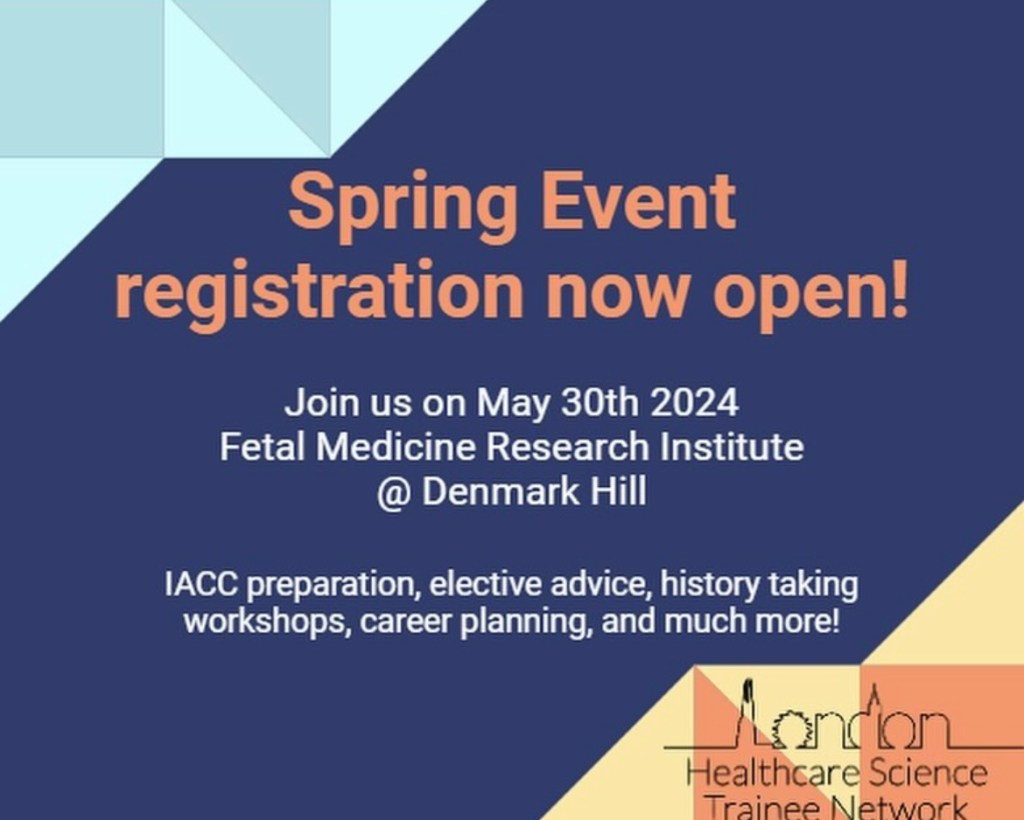
This full day training event will include a range of sessions designed to support your STP experience and also help you tick off some Professional Practice/Professional Foundations competencies.
While the full Agenda is waiting to be confirmed, we are excited to announce that in addition to hosting sessions on career pathways after the STP and STP elective experiences, we will once again be offering specialised talks aimed at helping trainees complete training activities/competencies that may otherwise be hard to target:
Toby Gibbons, the Clinical Coding Training Manager at Guy’s and St.Thomas Hospital will once again be joining us to deliver a talk which should help trainees in their third year complete SCC110 [18] (Use clinical coding and medical terminology in accordance with stated guidance, as appropriate to scope of practice). As for 1st and 2nd years this will still be an interesting talk to help better understand different aspects of HCS.
We understand that many trainees are struggling with how to comple S-C1 TA4 (Audit your digital footprint for adherence to your organisations policy and professional standards, and make recommendations for future professional and personal practice). To support trainees in this, current STP’s will talk through their approach to getting this competency signed off.
Additionally, Dr. Gillian Twigg, a Prinicipal Clinical Scientist & Diagnostic Sleep Service Lead at Imperial College Healthcare Trust will be returning to deliver a talk on patient history taking. This talk will help address learning outcomes 3 and 4 of S-C1 Professional Practice module. Please note, this will be part of the afternoon patient history taking workshop. To attend this talk please make sure to book a ticket that includes the workshop.
WORKSHOPS
Separate to registering for the training day interested trainees will have the opportunity to separately register for one of two workshops, both of which will run at the end of the day. Please note that as these run side by side it will not be possible to attend both.
PATIENT HISTORY TAKING WORKSHOP (16 spaces only): To complement Dr. Gillian Twigg’s presentation, we have invited two actors from Alchemist to participate in our patient history-taking workshop once again this year. These actors will portray patients, offering trainees a valuable opportunity to develop their clinical communication skills and to receive immediate feedback from our workshop facilitators.
IACC PREPARATION WORKSHOP: To help support 3rd years in the run up to the end-point assessment we are excited to be offering an IACC preparation workshop to help prepare for the IACC interview. Please note this workshop will be available to 3rd year STP’s only
FURTHER TOPICS
Please bare with us while we finalise the rest of the agenda for the 2024 spring Event. However you may expect further talks to focus on:
Last Tuesday marked the first case club session delivered by the new HCSTN committee, and it proved to be a resounding success!
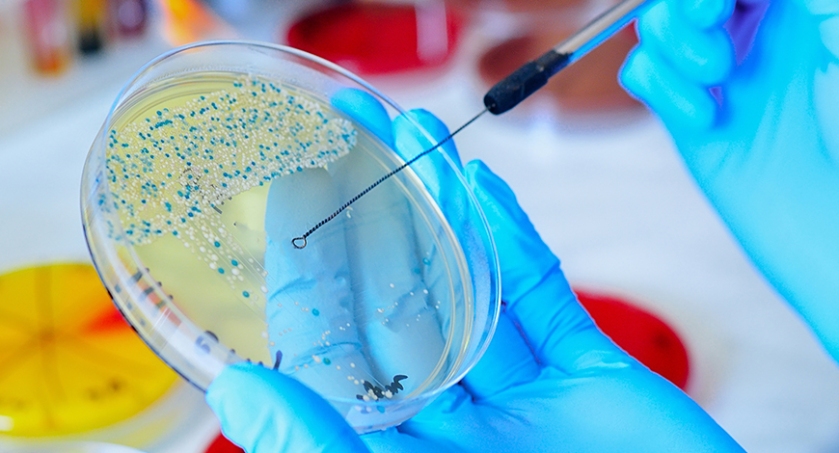
Emily, a final year STP in Clinical Microbiology, presented an engaging and thought-provoking case about a soldier who presented with multiple wounds infected by several species of bacteria, one of which exhibited resistance to all available antibiotics.
It was great to see that trainees from a range of specialties including Biochemistry, Genomics and Microbiology joined the meeting, and we had a very interesting discussion encompassing topics such as:
The requirement for tracking and reporting of antibiotic-resistant infections to government authorities
Regional disparities in the prevalence and types of antibiotic-resistant infections
The evolving landscape of antimicrobial therapies, including phage therapy and the use of silver as an antimicrobial agent
We also discussed the importance of developing new antibiotics, and agreed that the rise in antibiotic-resistant infections is a serious threat to global health that requires significant attention and innovation.
We’re still looking for a presenter for November’s case club, so if you’re interested please email londonhcstn@gmail.com. Hopefully see you all next month!
Imperial College Healthcare NHS Trust’s Radiation Physics Department, hosts the London North Training Consortium, a collaboration of seven major London NHS Trusts, and employs twenty-five Trainee Clinical Scientists, following Health Education England’s 3 year post-graduate Scientist Training Programme (STP).
A number of trainees stepped up during the first wave of the of the COVID-19 pandemic to assist the highly-skilled team of Critical Care Technicians, led by Paul Clements.
During the second wave of the COVID-19 crisis, a number of the same and additional trainees volunteered for redeployment to the ICU units across Imperial College Healthcare NHS Trust. The trainees were led and trained by the incredible technologists working there, who in return received help from a group of eager trainee physicists (and a bioinformatician). The trainees learnt a range of new skills, including how to test, service and set up equipment, such as ventilators and blood-gas analysers, ready for use on the wards. To give you a flavour of the experiences of the redeployed trainees, here are a few lines from each of them:
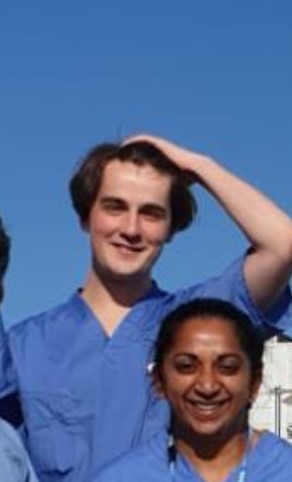
Name: Fred Varley
Specialism: Medical Physics (Imaging with Ionising Radiation)
Year: 2nd
Hospital: Charing Cross
One thing you’ve learnt: Every machine has different alarm to get your attention, and I know far too many of them by heart now.
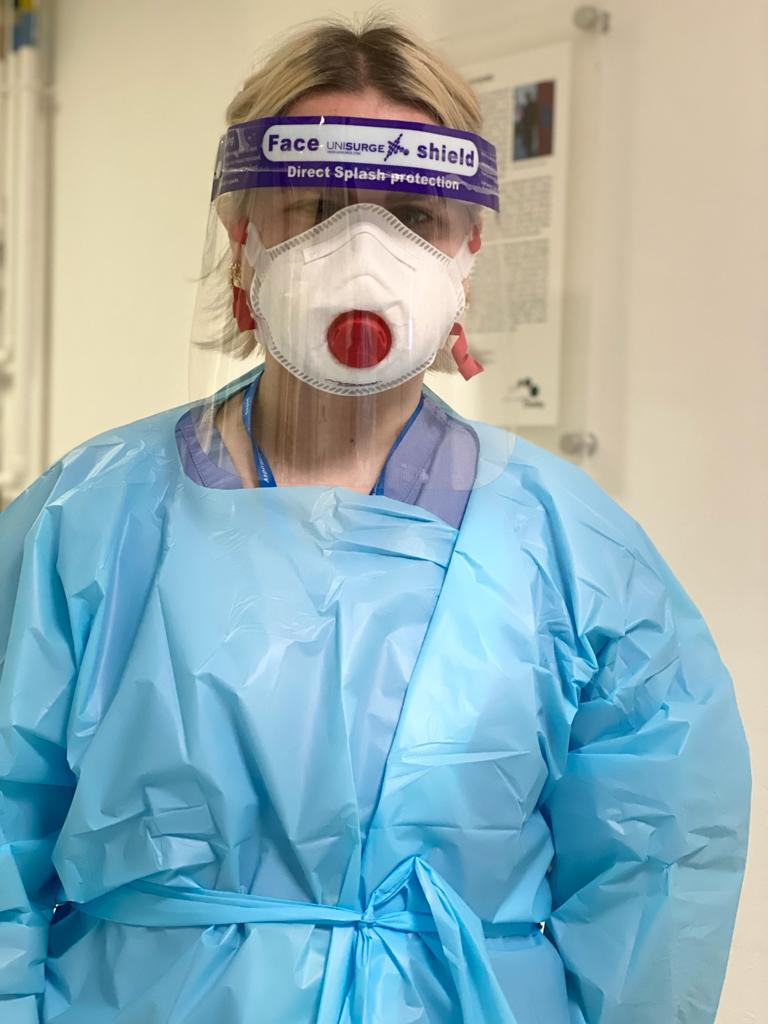
Most memorable moment: Going through air-tight mask-fit testing and having a bitter mist sprayed in my face to see if it works… But going into wards in full PPE afterwards it was incredible to see how calmly and quickly the ITU staff were able to work in such an uncomfortable and stressful environment.
Figure 1: Fred Varley
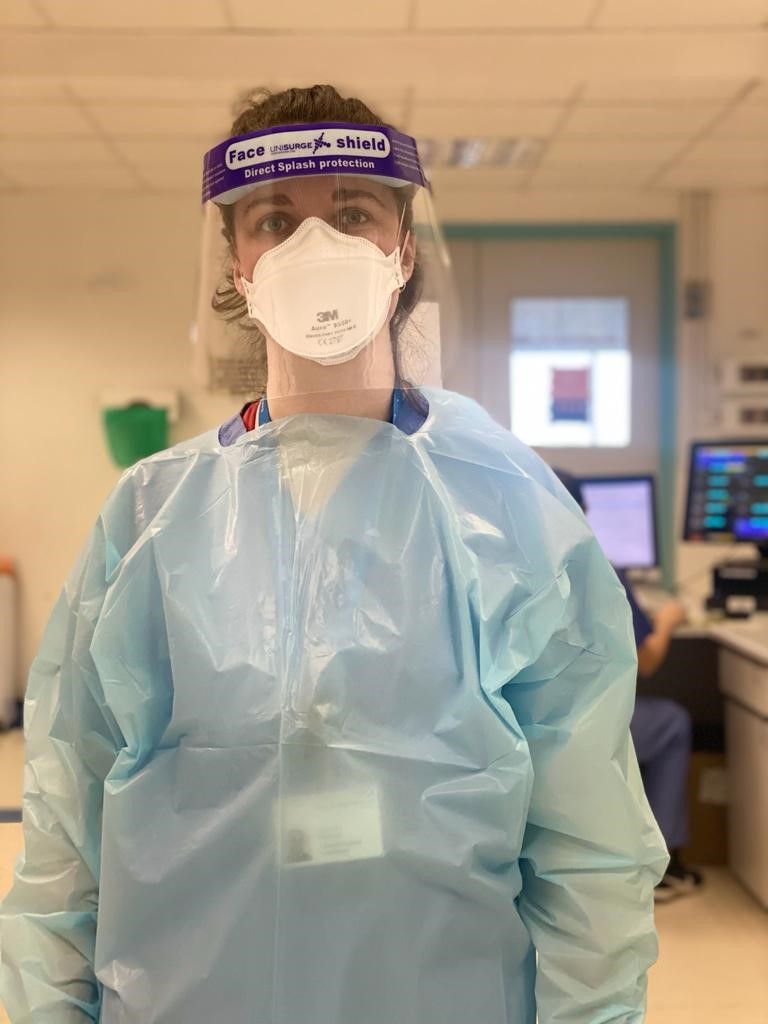
Name: Meagan de la Bastide
Specialism: Medical Physics (Radiotherapy)
Year: 3rd
Hospital: Charing Cross
One thing you’ve learnt: How to test and prep a ventilator, and also not to take your health for granted!
Most memorable moment: Helping to re-calibrate a blood-gas analyser on a very busy COVID positive ward. We had to maintain a sense of calm in the midst of a very stressful environment in order to get the job done.
Figure 2: Meagan De La Bastide
Name: Molly Buckley
Specialism: Medical Physics
Year: 1st
Hospital: Charing Cross
One thing you’ve learnt: I learnt how a CO2 flow sensor works.
Most memorable moment: My most memorable moment was seeing the view from 11th floor for the first time.
Figure 3: Molly Buckley
Name: Oscar Lally
Specialism: Medical Physics (Imaging with Non-Ionising Radiation)
Year: 2nd
Hospital: Nightingale and Hammersmith
One thing you’ve learnt: I learned how important science and technology is in ICU and how frequently it is relied upon.
Most memorable moment: My most memorable moment was having a sign language conversation with a patient who had just come out of a coma that had lasted months over Christmas.
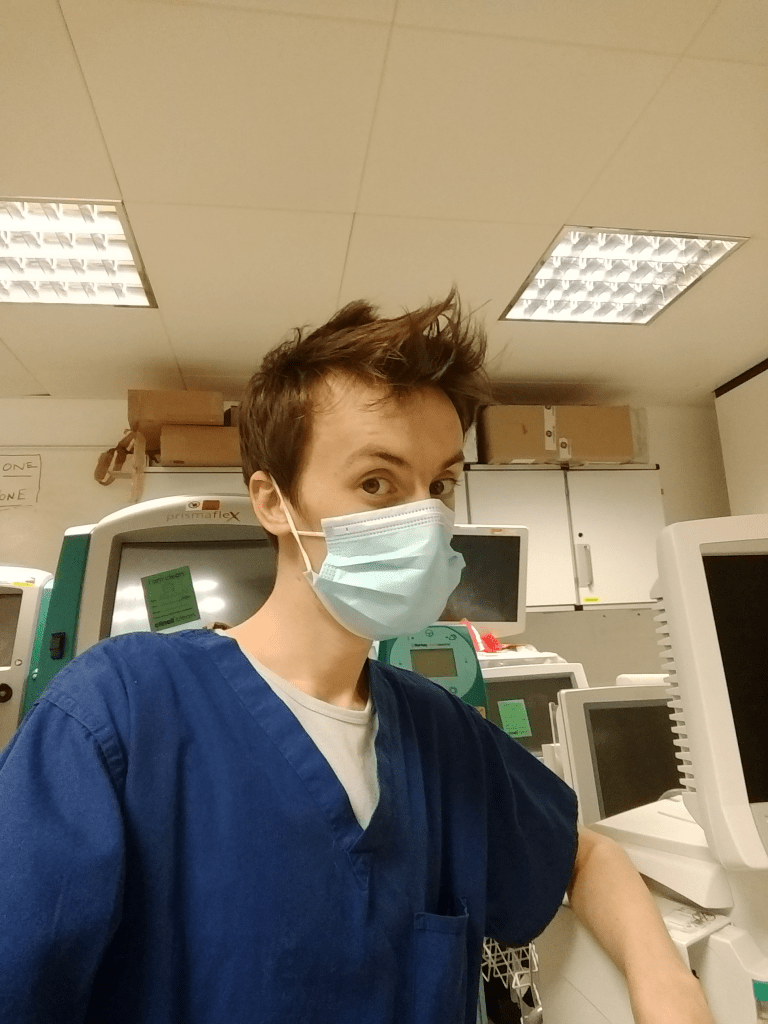
Figure 4: Oscar Lally
Name: Aggie Peplinski
Specialism: Medical Physics (Imaging with Non Ionising Radiation)
Year: 3rd
Hospital: Charing Cross
One thing you’ve learnt: I learnt lots about how all the equipment works that keeps people alive in intensive care.
Most memorable moment: Meeting and working with a whole new lovely team.
Figure 5: Aggie Peplinski
Name: Faissal Bakkali Taheri
Specialism: Medical Physics
Year: 1st
Hospital: Charing Cross Hospital
One thing you’ve learnt: COVID redeployment has affected staff at all levels: medical physicists who become assistant technologists, junior doctors who become healthcare assistant, and nurses who worked at almost all levels of nursing. Patience and flexibility really were keys in allowing the whole of ICU to work as efficiently as humanly possible.
Most memorable moment: Just being there helping the team, made the time at the ICU memorable. Even though the work we did wasn’t that difficult, it alleviated the burden of senior members of staff, who were then able to dedicate precious time to more challenging situations.
Figure 6: Faissal Bakkali Taheri
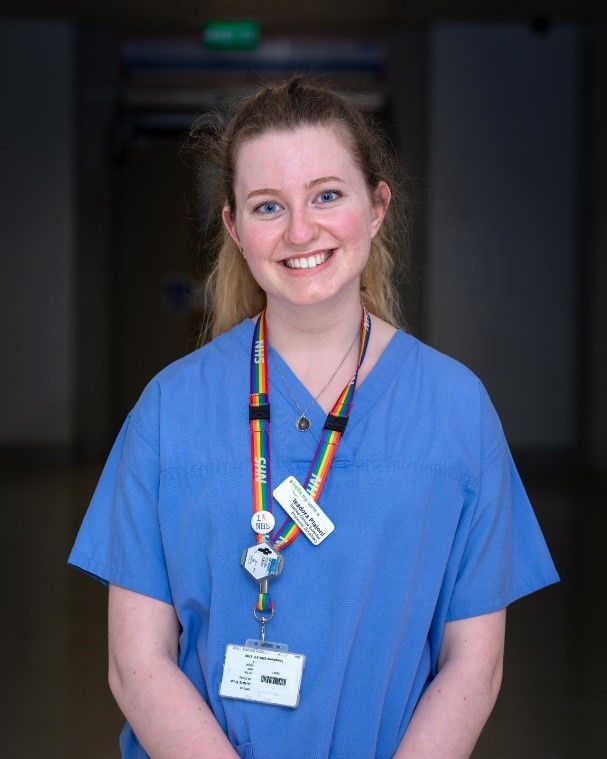
Name: Isadora Platoni
Specialism: Bioinformatics (Physical Sciences)
Year: 2nd
Hospital: Charing Cross Hospital
One thing you’ve learnt: How to translate between nurse-speak, doctor-speak and tech-speak. All surprisingly different. Most memorable moment: It’s difficult to choose just one moment, as every day was so different. However, my most memorable moment would probably be trying to fix the ventilator of a patient who’d recently had a tracheostomy, despite everything (including the piercing noise of the ventilator alarming) he was smiling and waving at anyone who came to help.
Figure 7: Isadora Platoni
Name: Alice Carlin
Specialism: Medical Physics (Radiotherapy)
Year: 2nd
Hospital: St Mary’s
One thing you’ve learnt: I have learnt about the extensive equipment required to monitor and support patients who are critically ill and the importance of multidisciplinary work in ensuring that patients receive best care.
Most memorable moment: Probably the first time I walked into an ICU ward as the environment is completely different to my usual department.
Figure 8: Alice Carlin
We’d like to extend our thanks to Paul Clements, Arthur Plewa and the whole Critical Care Technology team for the opportunity!
At this year’s Healthcare Science Education
2019 event with a focus on “What is the role of collaboration in education?”
the trainee network board members were invited to facilitate a session on How to select your research project. The
session involved stake holders of various levels including trainees, trainers
and assessors. Thank you to the session participants for sharing their points
of view on How to select your research
project.
The workshop focused around some key
questions, the answers that resulted from the discussions are summarised below:
Question 1: What makes a good research project?
Specific goal
Reasonable time frame
Good supervision
Money and resources
Patience
Impact on the department
Question 2: How might a trainee’s research project benefit your workplace?
Help to boost the research
output, since the trainee in supernumerary
Improve the service by
developing new skills, and technology which can be shared with the department
Raise the profile of the
department
Keep the department up to date
with current research
The trainee can help complete
additional projects
Question 3: Regarding previous projects in your workplace or that you have been
involved in – what aspects were successful or unsuccessful?
Successful:
Trainee presented their idea
for a project to the department, so potential problems could be identified and
gain support/contacts within the department
Supervisor could give
introductions to researchers currently doing work in the area
Great posters and publications
were produced to share the work being carried out
Ethics approval: Join and
taking ownership of a part of a project that already has ethics approval
Carrying out a project that
doesn’t require a lengthy ethics approval process
Regular meetings with
supervisors
Developing contacts through
supervisors
Supervisor enthusiastic about
the project
Developing contacts across
different areas
Unsuccessful:
Involving only one member of staff that understands the project, because if they unexpectedly leave, the trainee is less supported – Trainee shouldn’t only rely on one supervisor but a team of people
People failing commitments e.g. not supplying samples – Need written confirmation and a plan B for everything and everyone.
Project does not involve problem solving
Question 4: What are some of the biggest barriers to facilitating a successful
research project?
Ethics approval takes time – supervisor should advise on limitations
Experience of supervisor
Time constraints with conflicting schedules
Money
Team fulfilling roles
Time constraints on ambitious projects – Projects should have a narrow focus, with the underlying aim to gain MSc
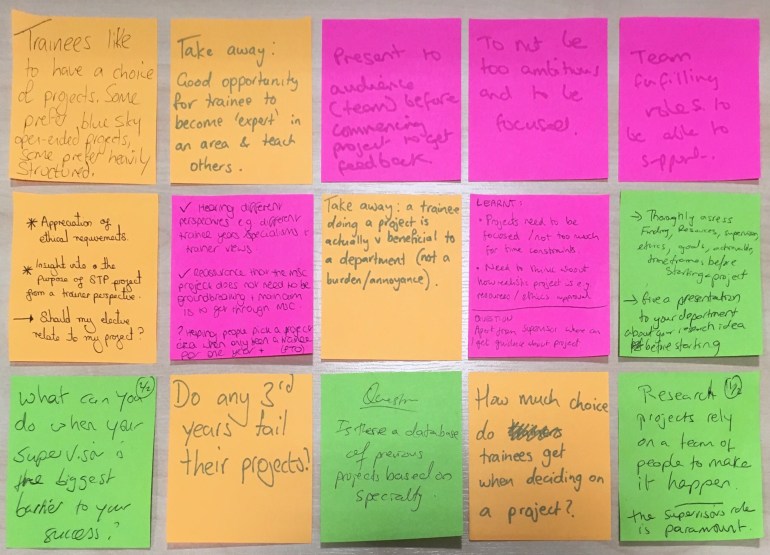
This is the feedback from the session attendees, collected via post-its shown in the image below:
The main points people took away were:
A trainee doing a project can actually be very beneficial to the department (not a burden/annoyance)
Projects reply on a team of people to make them happen
The supervisor’s role is paramount
Appreciation of challenges to gaining ethical approval
Insight into the purpose of STP project from a trainer’s perspective
Projects need to be focused / not too much for time constraint
Need to think about how realistic a project is e.g. resources / ethics approval
Questions people still had at the end were:
Do any 3rd years fail their projects? There are a range of grades achieved, but due to the high standard of candidates failure is very unlikely. Trainees should get regular feedback from supervisors as the project progresses to keep on track.
Is there a list of where students can access research grants? There isn’t a list and it may use up your valuable time looking and applying for grants
How much choice do trainees get when deciding on project? This depends on the department, some departments have a specific project they have been waiting for a trainee to do, and some give a choice of projects.
Apart from the supervisor where can I get support? Good people for support are your peers and colleagues from work.
Is there any help for trainees to pick a project who have not spent much time in their department due to rotations? Not a problem, talk to people in the department, to get an idea of what people are interested in. University supervisors may also be able to give input on what projects are good.
Should my elective relate to my project? No, the elective is separate to the project.
What do you do if your supervisor is the biggest barrier to your project? Find someone else in the department to help you, or schedule a time to speak with the supervisor, to remind them of their commitments, and make use of the academic supervisor.
The fourth LondonHCSTN board meeting of 2019 began with a big announcement. But we’ll save the best for last. First, a summary of the minutes.
The LondonHCSTN board applications are still open. There’s a persuasive list of reasons to join on our website, along with a link to the application form. Applicants will know shortly after the deadline (8th July) whether they’ve been successful. We’re trying to encourage more first year trainees to apply – You can help by simply sharing the link!
Haroon Chughtai represented the LondonHCSTN at the London Healthcare Science Workforce Group meeting last month. A key message was that Health Education England (HEE) are driving efforts to gather accurate workforce data on the number of healthcare scientists in London. On September 6th, we’ll be hosting a workshop at the London Healthcare Science Education Conference. The details are coming soon but in the meantime, applications are open. Spaces go fast.
We’ll be posting healthcare science facts to our social media platforms in the coming month. Our aim is to promote the work that healthcare scientists do to contribute to clinical services across the NHS. Anyone can get involved, so please email us to register your interest.
Third year STPs need no reminding that the OSFAs are coming up. We’re organising a big post-OSFA social for all London trainees. Keep an eye on future newsletters for details.
And the big announcement? Our co-chair Haroon Chughtai has been shortlisted for a HEE HEAT award for his improvements to training both in and out of his trust! Haroon and co-chair Stef Piatek, who recently won the NHS Healthcare Science Rising Star award, are coming to the end of their STP programmes. They’ll be missed and they’ve done an excellent job overseeing the events, socials and communications from the LondonHCSTN this past year.
The new board members will be inducted in August. But rest assured, we’ve been taking notes from our co-chairs all year.
One of our trainees attened the NHSE CSO’s Annual Conference a couple of weeks ago. Read on for a summary of the event and thoughts about the event.
By Haroon Chughtai
On the 7th and 8th of March healthcare scientists from across the nation descended upon London to attend the Chief Scientific Officer’s Annual Conference. This year’s event was entitled “Leading the Future – 2030” and focussed on how healthcare scientists are and can work nationally to drive the future NHS. This was the second year that I’ve had the opportunity to attend, and as last year, it was an inspiring and thought provoking experience.
CS-Who’s Conference?
Before I describe some of the talks and topics that were discussed, a little bit of background. The conference is hosted by NHS England’s Chief Scientific Officer, Dame Professor Sue Hill, who is the lead for the NHS’ healthcare science workforce. In addition to this, you may have heard her name as the lead in establishing the NHS Genomic Medicine Centres and spearheading the NHS contribution to the 100,000 Genomes Project.
The format of the day included plenary sessions, interactive panel discussions and workshops, as well as ample time for networking.
HCS & the LTP
What we’re trying to achieve
A significant focus of the two days was looking ahead to what the role of healthcare scientists will be in the delivery of the NHS Long Term Plan. Rather than go through each talk, here’s a quick summary of three of the themes covered during the two days.
The Digital Agenda
One of the key themes that was present was around how digital transformation is an essential enabling step to deliver the future we wish for our staff and patients. This forms a large part of the underlying infrastructure needed for delivering the Long Term Plan, as well as in enabling the areas highlighted in The Topol Review.
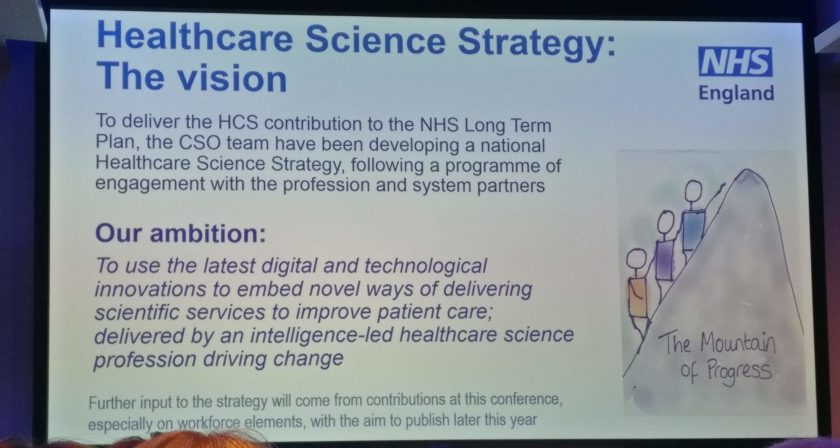
A slide from Matthew Swindells’ talk
Matthew Swindells, NHS England’s National Director for Operations and Information presented some ideas on how the NHS would be using better digital platforms to support care across healthcare. Only by being able to share information easily, effectively and securely between groups that need it can we have a future where we are able to make an informed decision for a specific person’s healthcare no matter if their GP is in Carlisle, they’re admitted to a hospital in London, and have their samples analysed by a lab in Manchester.
The Impact on Primary Care
Such a challenge was highlighted by Dr. Nikki Kanani, a GP in south-east London and Acting Director of Primary Care for NHS England. She spoke of how primary care is changing as people now have increased access to their personal data – in her case, a patient attending a clinic with a couple of their genetic data on a memory stick. Such changes will occur whether or not the NHS drives them, so we must keep up to ensure that we can continue providing the care that people expect. Dame Prof. Sue Hill mentioned how this may require more involvement of healthcare scientists in the community as point-of-care technology and other diagnostic tests become even more ubiquitous.
Partnering and Innovating
The thought of working with industry causes some in the NHS to shrink back in fear – however a number of speakers mentioned the advantages to the patients, the NHS, and themselves. The challenge is in ensuring that the NHS and our patients get the benefit of such collaborations as much as commercial companies do.
One of the main themes of the two days
Dr Liz Mear, Chief Executive of the Innovation Agency spoke of the work being done with The Academic Health Science Network to help spread innovation more effectively in the NHS so that health can be improved and economic growth generated.
This theme of partnering and innovating was also emphasised by Professor Tony Young OBE, the National Clinical Lead for Innovation at NHS England. He spoke of the Clinical Entrepreneur Programme which gives healthcare professionals the opportunity to develop innovations from within the NHS. From my perspective as a trainee clinical informatician who spends much of my time developing software, it is an exciting indication that there are opportunities for innovation without having to jump over to the private sector. One of the workshops on the second day expanded on this further to point out the benefits of partnering to improve information and knowledge across industry and the NHS through Knowledge Transfer Partnerships.
In Summary
I left the CSO’s Conference with a sense of excitement about the vision for the NHS’ next decade, and the place that Healthcare Scientists can and should have in it. There is always a lot of work to do to go between national policy and local implementations, but I truly think that all of us have a part to play in making that happen, whatever our formal positions. This echoes advice given by Kiran Chauhan, a Senior Development Adviser at NHS Improvement, who gave advice to “get involved beyond your remit and support your organisation more widely”. My take home messages for the future of Healthcare Science, were to seek partnerships to improve our services wherever we can find them and to work across specialisms, disciplines, and professions. After all, we’re all here to get the best for our patients.
Do you have an interest in fertility, sexual health or reproductive biology? Why not go to the Fertility 2018 conference! This is the largest conference of it’s kind in the UK, consisting of 3 full days of talks from worldwide experts and short oral presentations from clinics throughout the UK. There are also a number of social events that provide a great opportunity for networking with a variety of people from this field. All details can be found here:
This is your very first post. Click the Edit link to modify or delete it, or start a new post. If you like, use this post to tell readers why you started this blog and what you plan to do with it.








 The London HCSTN