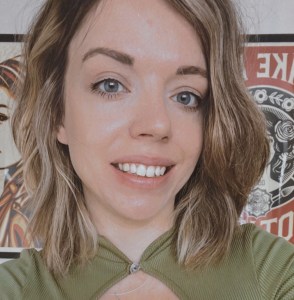
Vanessa
Co-Chair
Cancer Genomics Y2
I am based in the Haematological Malignancy Diagnostic service as Kings College Hospital where I’m primarily involved in contributing to the identification and quantification of molecular abnormalities and markers for diagnostic, prognostic and monitoring purposes in blood cancers. As part of my STP training, I’m also learning about genomic aberrations in solid tumours and how these relate to prognosis and treatment.
Advice for new trainees:
Be kind to yourself! You can’t be the best at everything and you will have periods where everything seems overwhelming, that’s normal. You’ll smash it, I promise.
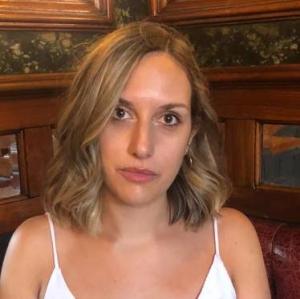
Elena
Co-Chair
Bioinformatics Y2
Coming from a background in genomic testing I started the STP as this this was an exciting opportunity to retrain in the rapidly evolving field of bioinformatics. Enabling me to continue to work within genomic healthcare, a field I am very passionate about, while also learning new skills in computational data processing, analysis, coding and software engineering.
Advice for new trainees:
The STP is a marathon, not a sprint, so don’t worry too much about what you need to do tomorrow, focus on what you know you can achieve today.

David
Co-Chair
Clinical Biochemistry Y2
My specialism of biochemistry aims to help with the diagnosis, prognosis and monitoring of patients, by looking at their biochemical analytes.
Day-to-day the role encompasses testing and interpretation of both routine and specialist tests. We ensure results make sense and fit the clinical picture, whilst also providing clinicians with guidance on what results mean, as well as what further testing may be appropriate.
There is also an emphasis on service improvement, through things like the R&D of new procedures and quality improvement of existing procedures.
Advice for new trainees:
Do not be afraid to use the support network! The STP is a unique role, with unique challenges. Platforms like the LHCSTN have been built specifically to be there for you, we’re more than happy to help
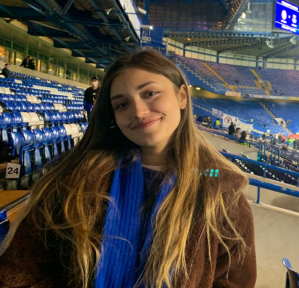
Khadijah
Social Media & Comms
Genomics Y2
Advice for new trainees:
If I could give any advice to the new trainees it would be to ask as many questions as you can!
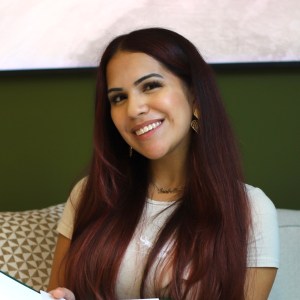
Isabella
Social Media & Comms
Clinical Engineering Y3
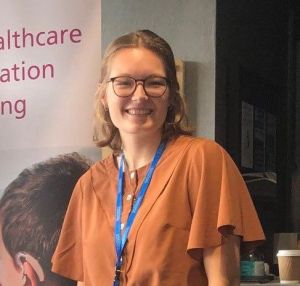
Hey everyone! I’m a Clinical Engineer specialising in Clinical Measurement & Development. We apply our knowledge of engineering principles to analyse data across a range of physiological measurements. We also manage & develop medical equipment and see patients often – best of both worlds!
Advice for new trainees:
Come out of your comfort zone and seek new opportunities to learn!
Sadie
Social Media & Comms
Bioinformatics Y2
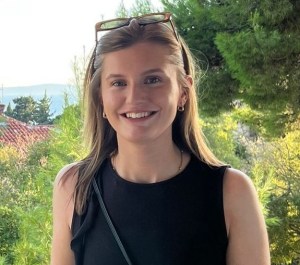
Bioinformaticians working within the Genomic Medicine Service utilise computational skills to process genomic data, this involves writing pipelines and building software and aids the interpretation of the data for diagnosis of rare disease and cancer.
Advice for new trainees:
Get to know your cohort and other trainees, their support will be invaluable!
Emily
Social Media & Comms
Microbiology Y3
Advice for new trainees:
Really use the people around you for help, especially those who’ve been through the STP before

Georgia
Case Club Co-Lead
Genomics Y2
As a Trainee Clinical Scientist in Genomics, I am responsible for examining a patient’s DNA to identify whether they have an alteration that could be responsible for an inherited or acquired disease, such as cystic fibrosis or cancer.
We use this information to help predict whether other family members or future generations are at risk of the disease, and also to help us to tailor treatment strategies to the patient to improve outcomes.
We work closely with Genomic Counsellors, doctors in genetics, Clinical Scientists in Bioinformatics, and specialist nurses.
Advice for new trainees:
Take ownership of your professional development – keep an eye out for further training opportunities and chances to widen your learning both within and outside of your specialty!
Arianna
Case Club Co-Lead
Neurophysiology Y2
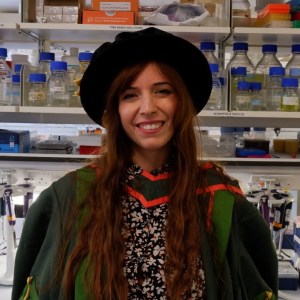
I am Arianna, a second year trainee in Neurophysiology at St Thomas’ hospital. In my training I am learning to perform tests on the central and peripheral nervous system, such as EEG, NCS and EP to diagnose a range of neurological disorders. I am in charge to organise the monthly case study meetings.
Advice for new trainees:
To new trainees I would just say do not be afraid to ask! I always put myself forward for new things and experiences and it really helped me get the best out of my training program so far!

Amy
Buddy Scheme Co-lead
Cardiac Science Y2
I’m an “In-service” candidate and was working as a cardiographer at my Trust before interviewing for the internal STP position. During my first year, I developed ECG knowledge in both performing and interpreting (Holter analysis) and am starting to have more opportunities in learning echocardiography and my role in supporting patients in cath labs. My position enables the choice between echo or pacing and I am currently just enjoying every opportunity to learn.
Advice for new trainees:
The STP can be very stressful but make sure you enjoy yourself! Maintain your social activities, keep active to manage your wellbeing and remember that you’ve done hard things before, you can do this!
Saskia
Buddy Scheme Co-lead
Genomics Y2
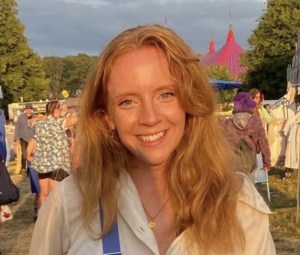
‘Hi, my name is Saskia, I’m in my 2nd year of the Genomics STP. My specialism looks at changes to the genome to determine whether these changes are contributing to a patient’s symptoms or can predict the onset of a condition later in life or the risk to other family members. Genomics Clinical Scientists are responsible for triaging referrals so they receive the correct testing, analysing results, writing reports, and troubleshooting laboratory processes, amongst other responsibilities. My role on the committee this year is Buddy Scheme Co-lead organising and managing the pairing of buddies and supporting their progression within the scheme.
Advice for new trainees:
My piece of advice for first year trainees would be don’t panic if at first you feel like you’re not contributing to the service. You’re supernumerary, and it can be a bit shock going from a very hands on role, to a mainly observational one in first year. Don’t worry, your time will come to contribute and this year observing is important for your training.
 The London HCSTN