The fourth LondonHCSTN board meeting of 2019 began with a big announcement. But we’ll save the best for last. First, a summary of the minutes.
The LondonHCSTN board applications are still open. There’s a persuasive list of reasons to join on our website, along with a link to the application form. Applicants will know shortly after the deadline (8th July) whether they’ve been successful. We’re trying to encourage more first year trainees to apply – You can help by simply sharing the link!
Haroon Chughtai represented the LondonHCSTN at the London Healthcare Science Workforce Group meeting last month. A key message was that Health Education England (HEE) are driving efforts to gather accurate workforce data on the number of healthcare scientists in London. On September 6th, we’ll be hosting a workshop at the London Healthcare Science Education Conference. The details are coming soon but in the meantime, applications are open. Spaces go fast.
We’ll be posting healthcare science facts to our social media platforms in the coming month. Our aim is to promote the work that healthcare scientists do to contribute to clinical services across the NHS. Anyone can get involved, so please email us to register your interest.
Third year STPs need no reminding that the OSFAs are coming up. We’re organising a big post-OSFA social for all London trainees. Keep an eye on future newsletters for details.
And the big announcement? Our co-chair Haroon Chughtai has been shortlisted for a HEE HEAT award for his improvements to training both in and out of his trust! Haroon and co-chair Stef Piatek, who recently won the NHS Healthcare Science Rising Star award, are coming to the end of their STP programmes. They’ll be missed and they’ve done an excellent job overseeing the events, socials and communications from the LondonHCSTN this past year.
The new board members will be inducted in August. But rest assured, we’ve been taking notes from our co-chairs all year.
One of our trainees attened the NHSE CSO’s Annual Conference a couple of weeks ago. Read on for a summary of the event and thoughts about the event.
By Haroon Chughtai
On the 7th and 8th of March healthcare scientists from across the nation descended upon London to attend the Chief Scientific Officer’s Annual Conference. This year’s event was entitled “Leading the Future – 2030” and focussed on how healthcare scientists are and can work nationally to drive the future NHS. This was the second year that I’ve had the opportunity to attend, and as last year, it was an inspiring and thought provoking experience.
CS-Who’s Conference?
Before I describe some of the talks and topics that were discussed, a little bit of background. The conference is hosted by NHS England’s Chief Scientific Officer, Dame Professor Sue Hill, who is the lead for the NHS’ healthcare science workforce. In addition to this, you may have heard her name as the lead in establishing the NHS Genomic Medicine Centres and spearheading the NHS contribution to the 100,000 Genomes Project.
The format of the day included plenary sessions, interactive panel discussions and workshops, as well as ample time for networking.
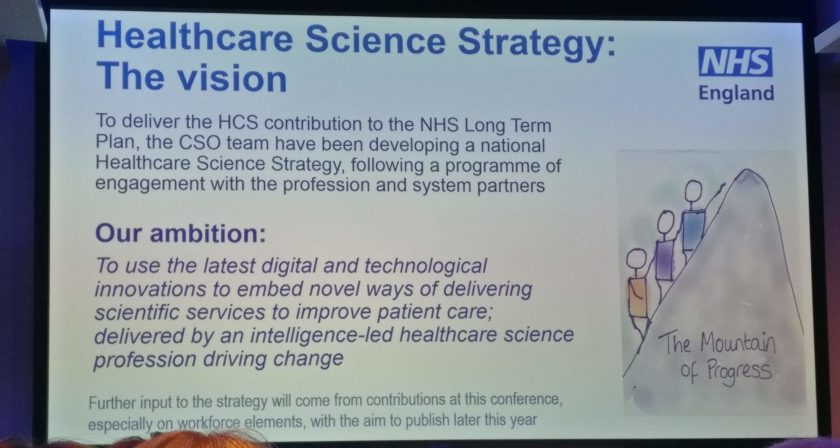
HCS & the LTP
What we’re trying to achieve
A significant focus of the two days was looking ahead to what the role of healthcare scientists will be in the delivery of the NHS Long Term Plan. Rather than go through each talk, here’s a quick summary of three of the themes covered during the two days.
The Digital Agenda
One of the key themes that was present was around how digital transformation is an essential enabling step to deliver the future we wish for our staff and patients. This forms a large part of the underlying infrastructure needed for delivering the Long Term Plan, as well as in enabling the areas highlighted in The Topol Review.
A slide from Matthew Swindells’ talk
Matthew Swindells, NHS England’s National Director for Operations and Information presented some ideas on how the NHS would be using better digital platforms to support care across healthcare. Only by being able to share information easily, effectively and securely between groups that need it can we have a future where we are able to make an informed decision for a specific person’s healthcare no matter if their GP is in Carlisle, they’re admitted to a hospital in London, and have their samples analysed by a lab in Manchester.
The Impact on Primary Care
Such a challenge was highlighted by Dr. Nikki Kanani, a GP in south-east London and Acting Director of Primary Care for NHS England. She spoke of how primary care is changing as people now have increased access to their personal data – in her case, a patient attending a clinic with a couple of their genetic data on a memory stick. Such changes will occur whether or not the NHS drives them, so we must keep up to ensure that we can continue providing the care that people expect. Dame Prof. Sue Hill mentioned how this may require more involvement of healthcare scientists in the community as point-of-care technology and other diagnostic tests become even more ubiquitous.
Partnering and Innovating
The thought of working with industry causes some in the NHS to shrink back in fear – however a number of speakers mentioned the advantages to the patients, the NHS, and themselves. The challenge is in ensuring that the NHS and our patients get the benefit of such collaborations as much as commercial companies do.
One of the main themes of the two days
Dr Liz Mear, Chief Executive of the Innovation Agency spoke of the work being done with The Academic Health Science Network to help spread innovation more effectively in the NHS so that health can be improved and economic growth generated.
This theme of partnering and innovating was also emphasised by Professor Tony Young OBE, the National Clinical Lead for Innovation at NHS England. He spoke of the Clinical Entrepreneur Programme which gives healthcare professionals the opportunity to develop innovations from within the NHS. From my perspective as a trainee clinical informatician who spends much of my time developing software, it is an exciting indication that there are opportunities for innovation without having to jump over to the private sector. One of the workshops on the second day expanded on this further to point out the benefits of partnering to improve information and knowledge across industry and the NHS through Knowledge Transfer Partnerships.
In Summary
I left the CSO’s Conference with a sense of excitement about the vision for the NHS’ next decade, and the place that Healthcare Scientists can and should have in it. There is always a lot of work to do to go between national policy and local implementations, but I truly think that all of us have a part to play in making that happen, whatever our formal positions. This echoes advice given by Kiran Chauhan, a Senior Development Adviser at NHS Improvement, who gave advice to “get involved beyond your remit and support your organisation more widely”. My take home messages for the future of Healthcare Science, were to seek partnerships to improve our services wherever we can find them and to work across specialisms, disciplines, and professions. After all, we’re all here to get the best for our patients.
Every month the trainee network board meets to discuss in depth, items raised through remote communication during the preceding month. These may be for the organisation of our events, discussion of feedback, or coordination of other network activities.
Below you can find a summary of what we discussed at the last meeting. If you’d like something discussed at the next meeting, please drop us an email.
Every month the trainee network board meets to discuss in depth, items raised through remote communication during the preceding month. These may be for the organisation of our events, discussion of feedback, or coordination of other network activities.



 The London HCSTN